Somewhere: The Life of Jerome Robbins
by Amanda Vaill
I knew that George Balachine was a genius and that he was the Ballet Master and Maker of the New York City Ballet. I also knew that Jerome Robbins, a Broadway kind of dancer and choreographer, was considered to be the "other" Ballet Master of NYCB. I thought that Mr. Robbins was fortunate to be so well considered, as did he, I found out in this biography. But I did not realize just how talented (I have been cruising PBS and U Tube for videos) Mr. Robbins was, just not on Broadway, but in the ballet.
Mr. Robbins not only choreographed but developed (producing, writing, the music, the book, etc.) so many iconic and classic Broadway musicals of the 1950s, 60s, and 70s, with West Side Story, Gypsy, and Fiddler on the Roof as just the most familiar to most musical comedy connoisseurs and high school theater departments.
There was a little too much of the Russian shtetl (the background of Mr. Robbins' parents early in the book and his own discovery of heritage late in life and look, Fiddler on the Roof look!) in some parts of this book. But the American talented boy makes good, very good in America! parts and the Broadway history and the NYCB were the chapters that interested me the most.
Men Explain Things to Me
by Rebecca Solnitz
All about Mansplaining in the Wide World of Boys.
Yeah, I get it. I got it from the Supreme Court just recently. There are things that Women just don't understand and they have to be taught by Wise Old Ugly Men. Ugh!
Showing posts with label biography. Show all posts
Showing posts with label biography. Show all posts
Sunday, July 6, 2014


Tuesday, May 28, 2013
The Worth of Geraldine Farrar
The history of Silent Film has always interested me. In my readings, I found it ironic that one of the early Silent Film stars was Geraldine Farrar who was a gifted and famous American opera singer of the early twentieth century. In the off-opera season, from 1915 to 1920, Miss Farrar starred in silent film where her vocal talents were unused but she did have "star quality" and she was a very good Operatic Actress and that was all she needed to achieve stardom in the film of that time.
She also had a core fan club of young women who adored her and called themselves "Gerry Flappers". I am sure that they all saw her films at least once if not twenty times.
Miss Farrar was born in Massachusetts and her musical ability was recognized by her mother at an early age (5 years old) and nurtured. Miss Farrar was an only child so her mother's attention upon her was absolute.
At the age of fourteen, Miss Farrar was giving recitals and those recitals brought her to the notice of The Bonds of Boston who bankrolled Miss Farrar's further education to sing opera. Miss Farrar sought her advanced education in Europe and it was in the turn of the century Germany that she gained notice and earned her reputation as a soprano, much like Maria Callas of the later part of the twentieth century, who sang the emotions of the opera part. She had technique but it was the "acting" of the emotions of the part that was the most important part of the performance for her and her audience.
Miss Farrar made her American Metropolitan debut in 1906 and was the soprano who introduced the iconic and eponymous role of Madama Butterfly to American audiences. She was selected and coached by Puccini himself for the part. Although in her biography, she claims that she was his second choice.
The Autobiography of Geraldine Farrar was written by Miss Farrar in 1938. She has very fond memories of her career and life in Germany before World War I that carries over rather offensively to the 1930s. She finds no offense in Hitler's Germany.
She also divides the book into parts. One part is written by Miss Farrar with flourishes and innuendos and intransitive verbs and lush similes and flushed metaphors that makes the reader sometimes resort to diagramming the sentence to determine what is really being said.
For Example, she describes a tenor named Chaliapin:
"I am sure he was a kind if sometimes forgetful husband, and an affectionate father, in spite of having a brilliant reputation as conquistador in the domain of Amor. This was not difficult, given his tremendous artistic endowment, and the the undeniable attractions of a singularly elemental male."
In real speak, the man was a Horn Dog and had a Big Dong. And she knows, because she had him. And he and his Dong were Good.
In the other part of the "autobiography", Miss Farrar's mother writes with exactly the same style as Miss Farrar and despite the fact that she, the mother, is dead. I suppose we are to assume that this is some "auto"matic hand writing channeled from the dead mother's spirit. Miss Farrar's mom discreetly covers the heights of Miss Farrar's career and love life that it would be unseemly for Miss Farrar to boast directly about herself.
Miss Farrar had an affair with Crown Prince Wilhem in her Berlin Glory Days, but Miss Farrar's mom writes about what a lovely wife and kiddies that he had, and that she and Geraldine got to see them all the time and practically live with them because they were so close to Mrs. Wilhem. I guess that they had the bedroom on the other side of Prince Wilhem's boudoir. And all those adorable kiddies were Mrs. Wilhem's kiddies, all her own, not one of them was Miss Farrar's.
Miss Farrar's love affairs with Toscanini and Enrico Caruso among others are covered in much the same manner.
Miss Farrar's movie career ended in 1920 when she tore up her contract with Samuel Goldwyn when he told her that her movies didn't make money anymore. Miss Farrar was a New England business woman and she made movies because that was where the money was. Miss Farrar's singing career ended in the late 1920s when she wore out her voice by constant travel in her own private rail car all over the US, because that was where the money was. She did record extensively in the early twentieth century because that was where the money was and you can find some of these recordings on CDs today.
Miss Farrar was a Lady who knew her Worth and got her Worth in every way possible.
Monday, May 27, 2013
Eating Thoughtfully
Leonardo and The Last Supper by Ross King

The Last Supper by Leonardo da Vinci was an experiment in oil based paint on a plaster wall primed with a lead based white paint. Most wall murals of the time were frescos where the artist painted a very small part of the wall with pigments on a wet plaster.
Leonardo was in a creative mood after he had to give up his huge bronze horse cast statute and his flying machine design. He decided to do his art commission for a monastery wall in oil paints because no one else had ever done it that way. If you look at photos of The Last Supper as it is today, you see why no one had. The present mural is stripped paint and faint colors and indistinguishable characteristics of the figures and the food at the last supper.
Da Vinci also chose the wrong wall to paint. It was the north wall and prone to dampness even in good weather. The Last Supper was a mural artwork experiment gone very wrong.
But on the positive side, Leonardo did finish the mural. And Leonardo was well known by all art patrons in Milan as an artist who did not start or finish his commissions unless they were small paintings of individuals.
Leonardo was a thinker of great ideas. His art was just a hobby or a palate cleanser while he tasted another idea with dreams of architectural or engineering glory.
This was a new one for me---an artist who really wanted to be an engineer.
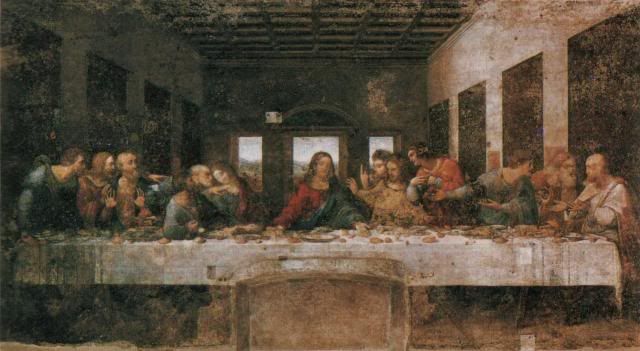
The Last Supper by Leonardo da Vinci was an experiment in oil based paint on a plaster wall primed with a lead based white paint. Most wall murals of the time were frescos where the artist painted a very small part of the wall with pigments on a wet plaster.
Leonardo was in a creative mood after he had to give up his huge bronze horse cast statute and his flying machine design. He decided to do his art commission for a monastery wall in oil paints because no one else had ever done it that way. If you look at photos of The Last Supper as it is today, you see why no one had. The present mural is stripped paint and faint colors and indistinguishable characteristics of the figures and the food at the last supper.
Da Vinci also chose the wrong wall to paint. It was the north wall and prone to dampness even in good weather. The Last Supper was a mural artwork experiment gone very wrong.
But on the positive side, Leonardo did finish the mural. And Leonardo was well known by all art patrons in Milan as an artist who did not start or finish his commissions unless they were small paintings of individuals.
Leonardo was a thinker of great ideas. His art was just a hobby or a palate cleanser while he tasted another idea with dreams of architectural or engineering glory.
This was a new one for me---an artist who really wanted to be an engineer.
Friday, April 12, 2013
Some Odd People
The Guilty One by Lisa Ballantyne
This book is a murder mystery that goes to trial where the truth to be discovered about the trial and whether the accused child murderer did what he is accused of is discernible about half way through the book and the trial.
The real mystery is why the child's attorney, or solicitor (this is a British mystery), is estranged from his adoptive mother and biological mother.
This is good trash reading.
That Furious Lesbian: The Story of Mercedes de Acosta by Robert A. Shanke
Mercedes de Acosta knew every one who was Any One in the early twentieth century. She was a lesbian groupie who slept with all the great lesbians of that age, Greta Garbo, Marlene Dietrich, Eva le Gallienne, Laurette Taylor, Alice B. Toklas, etc.
Miss de Acosta also wrote plays for the theater of the time and screenplays for Hollywood movies.
This is a good biography. It moves fast and explains the period and its people well to anyone who has not read much about it.
And Cecil Beaton was the one who called her a furious lesbian. Really Mr. Beaton, you are one to talk.
Traveling...
Eighty Days: Nellie Bly and Elisabeth Bisland's History Making Race Around the World by Matthew Goodman
Jules Verne was a very popular Science Fiction author of the late nineteenth century (before it was called "Science Fiction") who wrote a book, Around the World in Eighty Days, about a stodgy upper class Englishman who mixed too much gin and Napoleon brandy one night at his Men's Club in Kensington or Mayfair or where ever they have those sort of clubs, and got the idea to circumnavigate the globe ("This rounded and filled in and three dimensional 'O'", as Shakespeare would have called it if he were dealing in the three dimensions and time and space and had forgotten the beats in blank verse) in eighty days.
The Englishmen at his club were all betting men and took him up on it to the tune of half of his not inconsiderable fortune (you think that they let any one into those English Men's Clubs in Trafalgar Square?). And the Englishman took off to see the world. He was aided by the fact that the British Empire stretched across the globe, and in his travels, he could pretty much avoid the worldly riffraff who did not speak English or did not adhere to the punctuality of the British railways or steamships. The British pound was also a great help in his travels, it was a good as gold.
So much for Napoleon and his brandy, the British made an Empire that he could only dream of creating.
Nellie Bly was an intrepid girl reporter (she was 25, but "girl" makes her spunkier than "woman" and every one likes a Spunky Girl), who in her career at The New York World newspaper in the 1890's went undercover at the Woman's Insane Asylum to discover and report on its abuses and who joined the women's sweatshop brigade to report on the abuses suffered by the working girls of New York City---the "legitimate" working girls not the prostitutes. She never got that far in her undercover adventures as to take up prostitution.
Miss Bly liked to stand up for the working women and men and report on their lives. She didn't care about the New York City Robber Baron clans who ruled the papers with their money and their antics.
Miss Bly read Mr. Verne's book about traveling the world and spent several days perusing steamship schedules and railway schedules before she went into her editor's office and pitched the story that she, a girl with pluck and spirit, could beat the record of circumnavigating the world in eighty days, all by herself. Sales of the newspaper were dropping off and the editor accepted her story pitch.
Miss Bly went to her tailor and had him make her a traveling suit that would stand up under travel for under eighty days and packed her carpet bag, she was traveling light, no trunks or suitcases, and set off from New Jersey on a steamship across the Atlantic to some fanfare. The World made some money and increased its subscriptions on publicizing her trip around the world. Where in the World was Nellie Bly? (Carmen San Diego, you are such a poseur!)
But meantime unknown to our intrepid girl traveller and reporter, Nellie Bly, another "lady" traveller, Elisabeth Bisland, an editor for Cosmopolitan magazine was going to make the same world trip starting in NYC and going in the opposite direction, across the United States first.
The "Filly" Horse Race was ON! Who would win? Bets were taken and The World organized a sweepstakes, offering a all expense paid visit to Europe for the person who guessed the correct time that Miss Bly would alight from her train in New Jersey after her round-the-world trip. Of course, the arrival time was narrowed considerably by noting the arrival of the cross country train from its schedule.
This book follows the travels and adventures of our Traveling Ladies.
If I had been required as a traveling companion for either of the Ladies, I would have travelled with Miss Bisland. She actually did some sight-seeing and enjoyed her visits to other countries. Miss Bly was the proto-typical American traveller, she had to be somewhere and she had to be there in a hurry. Miss Bly was more worried about winning the race and making the trip in under eighty days to actually enjoy her travels or to notice much of anything around her.
Miss Bly was also an American chauvinist and nationalist. She brought American dollars and British pounds with her on her trip and was annoyed that no one wanted the dollars, the British pound was the desired world currency. Miss Bly also found that the British flag flying everywhere that she went was also an irritating sight. Ah Miss Bly, you were about fifty years too early on your world travels.
But then, Miss Bly did get to meet and visit with Mr. Verne on her world trip.
Sunday, April 7, 2013
Lazy Readings
I am still reading away, just a little too lazy to post about any of the books.
But now, back to the books that I have read.
1. Invisible Cities by Italo Calvino
From Kubla Khan by Samuel Taylor Coleridge
The story goes that Mr. Coleridge was writing the above poem in haze and daze of Opium induced delusion when some one knocked on the door and Mr. Coleridge gave up on the poem to entertain his guest---even Opium can't ruin the manners of a polite poet. When the guest left, Mr. Coleridge took a deep puff of the Magic Elixir, Opium, and tried to go back to his writing, but he had forgotten the rest of the poem. The moral of this story is that Opium and Manners don't mix.
Mr. Calvino, in his book, decided to continue Mr. Coleridge's poetry fragment by narrating a conversation between Marco Polo, famed Traveller, and the Kubla Khan, ruler of half the world, about the cities of the Khan's kingdom which was so vast that the Khan never visited most of them.
I like travel books even when they are about imaginary kingdoms and cities and this book is about the imaginary kingdom of the Khan.
Calvino---I wonder if Mr. Calvino was a Protestant? A Calvinist sort of Protestant?
2. Pierrepoint
Albert Pierrepoint was an English Hangman, back when Great Britain still had state executions, who hanged around 400 convicted criminals among them the staff of the concentration camp, Bergen-Belsen. He was accounted to be very good at his job. But he outlived his executing and took up campaigning against state executions at the end of his life.
This just goes to show that one's Youth and Old Age are two very differently experienced life periods for many people. One is not the same person that one used to be.
3. Alone on the Ice: The Greatest Survival Story in the History of Exploration by David Roberts
How I love any Arctic or Antarctic exploration stories of the nineteenth and twentieth century.
This one is about an Australian Explorer named Douglas Mawson, who after exploring with Ernest Shackleton, mounted his own Exploration Expedition and saw much more of the Antarctic than he expected or wished to. He ended up dragging his own dog sled (the dogs had all been eaten) for thirty days, ALONE by himself, in the inhuman desolation of Antarctica, back to his base camp which was located on the Windiest Place in the World.
Meanwhile, back at his base camp, the telegraph operator went insane and either wouldn't sent anyone's telegrams or sent indecipherable telegraphic ravings to the outside world about his persecution and perilous escape from being murdered by the remaining crew of the expedition at the base camp. It was wild times in Antarctic Exploration, those Aussies know how to party.
4. The Dinner: A Novel by Herman Koch
This is a murder mystery where the reader only regrets at the end that all the obnoxious characters, and they are many, weren't murdered.
But now, back to the books that I have read.
1. Invisible Cities by Italo Calvino
| IN Xanadu did Kubla Khan | |
| A stately pleasure-dome decree: | |
| Where Alph, the sacred river, ran | |
| Through caverns measureless to man | |
| Down to a sunless sea. | 5 |
| So twice five miles of fertile ground | |
| With walls and towers were girdled round: | |
| And there were gardens bright with sinuous rills | |
| Where blossom'd many an incense-bearing tree; | |
| And here were forests ancient as the hills, | 10 |
| Enfolding sunny spots of greenery. |
The story goes that Mr. Coleridge was writing the above poem in haze and daze of Opium induced delusion when some one knocked on the door and Mr. Coleridge gave up on the poem to entertain his guest---even Opium can't ruin the manners of a polite poet. When the guest left, Mr. Coleridge took a deep puff of the Magic Elixir, Opium, and tried to go back to his writing, but he had forgotten the rest of the poem. The moral of this story is that Opium and Manners don't mix.
Mr. Calvino, in his book, decided to continue Mr. Coleridge's poetry fragment by narrating a conversation between Marco Polo, famed Traveller, and the Kubla Khan, ruler of half the world, about the cities of the Khan's kingdom which was so vast that the Khan never visited most of them.
I like travel books even when they are about imaginary kingdoms and cities and this book is about the imaginary kingdom of the Khan.
Calvino---I wonder if Mr. Calvino was a Protestant? A Calvinist sort of Protestant?
2. Pierrepoint
Albert Pierrepoint was an English Hangman, back when Great Britain still had state executions, who hanged around 400 convicted criminals among them the staff of the concentration camp, Bergen-Belsen. He was accounted to be very good at his job. But he outlived his executing and took up campaigning against state executions at the end of his life.
This just goes to show that one's Youth and Old Age are two very differently experienced life periods for many people. One is not the same person that one used to be.
3. Alone on the Ice: The Greatest Survival Story in the History of Exploration by David Roberts
How I love any Arctic or Antarctic exploration stories of the nineteenth and twentieth century.
This one is about an Australian Explorer named Douglas Mawson, who after exploring with Ernest Shackleton, mounted his own Exploration Expedition and saw much more of the Antarctic than he expected or wished to. He ended up dragging his own dog sled (the dogs had all been eaten) for thirty days, ALONE by himself, in the inhuman desolation of Antarctica, back to his base camp which was located on the Windiest Place in the World.
Meanwhile, back at his base camp, the telegraph operator went insane and either wouldn't sent anyone's telegrams or sent indecipherable telegraphic ravings to the outside world about his persecution and perilous escape from being murdered by the remaining crew of the expedition at the base camp. It was wild times in Antarctic Exploration, those Aussies know how to party.
4. The Dinner: A Novel by Herman Koch
This is a murder mystery where the reader only regrets at the end that all the obnoxious characters, and they are many, weren't murdered.
Sunday, February 10, 2013
History Lessons
The Noir Forties: The American People from Victory to Cold War by Richard Lingeman
This book is an informal history of the United States from 1940 to 1950. After discussing a section of history, the one on the economics of the period is truly boring and it shouldn't be because this is when a steel workers strike could stop the US economy cold, the author attempts to connect it to a movie of the time that echoes the concerns and fears of that history section. When was the last time that anyone has ever been frightened by a strike lately? How Labor has Fallen.
The movie that the author discusses along with the strikes of the period is The Long Night directed by Anatole Litvak that stars Henry Fonda as a World War II veteran with a bad case of PTSD who kills some guy and then barricades himself in his apartment and has flashbacks all movie long. I haven't seen the movie yet so I don't know just how that relates to Strikes other than barricading oneself in one's room is sort of like walking a picket line in a strike. You can only hope someone is paying attention and if you kill someone, you do draw some notice from authorities and the media.
The history, other than the economic side, is mostly interesting and well presented by the author. The connection with some of the movies (the ones that I have seen) is slight to incidental. The author is really not all that interested in the movie correlation side of the book. I assume that his agent or publisher made him include the movies in the book to make it easier to sell. The author's own experiences in the time period, he was a drafted soldier in Army Intelligence in Japan, were much more interesting and well presented. I assume that correlating his own experiences with the history period was what he really wanted to do and probably was what he originally did in the book before he had to tart it up with Hollywood blondes.
What I took away from this book was that America was having a moment of Mass Fear and Hysteria and Paranoia in the later part of the forties. The loss of FDR must have been truly frightening despite the winning of the war. The similarities with present day America are also disconcerting. Once again we have elected officials like Senator McCarthy, only today we have many of them not just one, who manufacture Fear crises like the National Debt and Bengazhi!!! and the Second Amendment to advance their careers over the Real Life and the Truth and The Way that It Really Is.
Hmmmm, perhaps this is why Fantasy and Science Fiction and Magic movies are so popular these days. The crazies want us all to share their delusions.
The Entertainer: Movies Magic and My Father's Twentieth Century by Margaret Talbot
This is another history book about the times and the movies of those times. It is also a memoir of Lyle Talbot, an actor who began as a Magician's Assistant at the beginning of the 20th Century, starred in Roaming Theatrical companies and their plays, and then went to Hollywood at the beginning of the Talkies Movies and made his career as a B-movie lead and later as the best friend of Ozzie Nelson in TV.
The book is written by one of his daughters, Margaret, and she includes family history and reminisces to give an even more intimate picture of her father and his career and his family. Miss Talbot does a good job with remembering her father's and her past. Like Mr. Proust, it is the little things that she remembers that become the crux of the interpretation of her and her father's life. She also writes well.
As for Mr. Talbot, I have seen one of his Pre-Code movies, Three on a Match, (Bette Davis is in this one, but this is before Warner Brothers figured out just how interesting an actress that she was and was still making her play unremarkable Good Girls. When you think about it, it is amusing, Miss Davis found her Bad Girl after the Era of Bad Girls in the Pre-Code movies. It is also a tribute to Miss Davis' ability to handle subtlety and subtext in her acting and that is amusing because I don't often think of subtlety when I think of Miss Davis' acting.).
Any way, I liked Mr. Talbot and his character in the movie that I was watching mainly for Ann Dvorak, a Pre-Code Female Star. Mr. Talbot played a stinker with some moral scruples, you felt sorry for the poor sod. I have seen some episodes of The Adventures of Ozzie and Harriet which was The Cosby Show of the fifties and sixties. I hated his character on that one. Mr. Talbot played the obnoxious neighbor and best friend of Ozzie. His character was one of those "Hail Fellow and Well-Met" men with idiotic jokes and Loud Camaraderie, and that shows just how undervalued his acting skills were when you compare the two characters.
Mr. Talbot was also in some of Ed Wood's cult classic Bad Films.
Monday, December 24, 2012
Escape From Affluence and Poverty and Sentiment
Escape From Camp 14 by Blaine Harden is the story of Shin Dong-hyuk who was born and reared in a North Korean Internment Camp. His father and mother were inmates who were favored by the guards and allowed to breed. They produced two sons, Shin and an older brother, in their long and dreary and cruel incarceration. Both sons managed to escape the camp, but in completely different ways.
Shin long blamed his mother and father for making him to be born and live in such hellish conditions. Shin ratted out his mother and older brother to the authorities on their escape plans for extra food and served six months in dark cell isolation and being tortured before being brought out to the daylight to watch the camp authorities hang his mother and shoot his brother before his eyes. Shin and his father got front row seats for that piece of Camp Theater.
After the execution of his mother and brother, Shin was placed in a cell with an older man who told him wondrous stories of the Food outside of the camp. Shin, who was overworked, undereducated, malnourished, and fresh from six months of torture which included beatings and being hung to roast over a fire, and the deaths of this mother and brother which were caused by Shin's informing on them, conceived of escaping from the camp to get him some of that food.
Forget Freedom, Shin just wanted to be able to eat to satiation. By the way, the torture was about the same as living in the camp, beatings and overwork and isolation from the children around him and little or no food.
Later Shin left his cell with his Gourmand Inmate and made the acquaintance of a newly arrived North Korean who made the mistake of going back to North Korea after a few years in the relative benign freedom of China. Shin and the new inmate conceived a plan to escape the camp while cutting wood near the camp's electrical fences. They carried out the plan, but only Shin made it out. He used the body of his escape buddy to neutralize the Electrical Fence and crawled over his dead companion to Food.
Although with his education (they only taught rudimentary reading and writing skills to the children in-between work details and beatings), Shin had no idea where China was or what it was, Shin made it to China and spent three years in the country learning a few things about the world and eating Food. Later South Korea paid him to come to their country and after a de-briefing (tattling is one way to make it in the World), South Korea paid to maintain him there.
But the years of deprivation in Mind and Body, left Shin with long term Mental Illness Issues. He has never really adjusted to life outside the camp. Shin now lives most of the time in California where he lectures on his experiences and life in the North Korean Camp. He travels frequently to South Korea for visits.
During his torture session after ratting out his mother and brother, Shin was shown some papers that he was able to read. He found out that his father was in the camp because two of his brothers escaped to South Korea during the Korean War. The remaining family was sent to North Korean Camps because they were considered contaminated by the two brothers' escape. Somebody has to feed and work for the rest of North Korea and the Kim Jongs.
By the way, Shin didn't even know who the Kim Jongs were until he escaped. Education was very shallow even with propaganda for the Camp Kids.
Shin is one of three people who escaped from North Korean Camps. The interns of the Camps are so cowed and overworked and starved that most of them don't even attempt to run. And most who make the attempt end up like Shin's mother and brother.
Remember, it ain't Freedom that motivates. It is FOOD.
Seating Arrangements by Maggie Shipstead
This book was recommended by Salon.
I got about halfway through it, but I didn't find any of the characters interesting. They were all annoying in their privilege. And there was this Middle Aged Man who was hitting on one of his daughter's Bridesmaids. The Bridesmaid wanted it too. But I didn't want to read about it.
I see the recommendation was by a middle aged man. Well, that explains a lot.
Cascade by Maryanne O'Hara
This book was another recommendation.
It's about a woman artist of the thirties who makes all the wrong decisions (love and art) but comes out right in the end. Her father makes what appear to be the right decisions, but they go haywire.
The best woman artist of the thirties character was in The Big Clock, a classic noir book and film.
I guess that I am just not that sentimental.
Friday, April 27, 2012
In the Arctic
The Ice Balloon by Alec Wilkins
At the turn of the 19th Century into the 20th, one of the Great Adventures and Explorations was the physical trip to the North Pole, magnetic and geographic. Another Great Adventure and Exploration was the discovery of the Famed Northwest Passage from the Atlantic Ocean Across Northernmost America to the Pacific Ocean. From the sixteenth century onward, Europeans and later North Americans attempted to make it to the North Pole or across the Northern Arctic Archipelago from the Atlantic Ocean to the Pacific.
The Great Problem of a Trip to the North Pole was the fact that there was no Northern Continent like the Southern Continent of Antarctica to hold the Pole. In the Northern Arctic, there was the ever moving ice and frozen sea that impeded any journey to the North Pole. Ships could go so far in some years and then not go there in other years due to the changing ice. Ships were caught in the ice and some never got free of it and had to be abandoned. Arctic Explorers had to factor that the endlessly moving and forming and re-forming ice could trap them in an Exploration Trip for years before they could get out or be found or rescued.
The ice like time gave Uncertainty to the Venture. What was there to begin with might not be there later or have become something else unexpected in the future.
In 1897, a Swedish explorer named S. A. Andrée with two companions named Fraenkel and Strindberg attempted to be the first people (not even the Native Peoples cared to venture that far into the Uncertain North for no great advantage or rewards for them) to make it to the North Pole. Mr. Andrée's mode of transportation was a Hydrogen Balloon.
In that age, Mr. Andrée had no means of communication such as radio, he was going to use carrier pigeons to notify others (his country men and newspapers and the Royal Geographical Society of Britain) of his progress. He would also put messages on buoys that he would throw over the side and use the shifting ice to send the buoys to the Whalers who were the only people other than some of the Native Peoples to go that far North with any purpose other than Exploration.
Mr. Andrée and his balloon and companions like many Arctic Explorers disappeared into the North and was never seen again. He and his companions were lost in the Arctic.
In 1930, a Norwegian Sealing and Science sloop named the Bratvaag stopped at White Island in the Arctic Ocean and found the remains of Andrée's Expedition to the North Pole. Mr. Andrée and his companions had lost their lives and their heads, really, their bodies had no heads. Some diaries and pictures and artifacts and headless bodies were all that remained on the ice and trapped in the ice.
This book is about how it all came to that and naught.
The book also tells the horrific tale of Adolphus Greely, an American Explorer of the Arctic, who led an expedition to find the Lost British Expedition of Franklin who was trying to find the Northwest passage. (That is what Arctic Exploration was, some body was always looking not only for the North Pole or the Northwest Passage but also for some one who got lost looking for one or the other of the two.) Mr. Greely's Arctic Adventure makes the movies, The Thing or Hostel, look tame by comparison. Anything that an Imaginary Alien or depraved people can do to a traveller, the Arctic and Nature can do worse.
One amusing thing about Mr. Andrée's expedition was the fact that his companion, Strindberg, was confused with the playwright, August Strindberg; and Paul Gauguin, the painter, wrote to friend that he didn't understand why August Strindberg had taken it in his head to go to the North Pole in a balloon. August Strindberg also received a letter from his wife imploring him not to go exploring in the North.
Tuesday, April 24, 2012
Viewpoints
The Gnostic Gospels by Elaine Pagel
In 1945, a Egyptian, who was avenging his father's murder in a blood feud, discovered some rolls of papyrus in a large red clay jar. The Egyptian knew something about grave robbing and antiquities and put one of the papyrus rolls on the market to find out the value of what he and his brother had dug up. So, the Gnostic Gospels, another view of the life, death, and resurrection of Jesus came to the attention of Bible scholars.
The fundamentalists won the war of the Protestant and Catholic Bibles. They favored the hierarchical, rigid, Religion is the Church and its temporal judgements and demands and don't fall afoul of it version of the Bible. The Gnostics were more in the vein of God is what is inside you and is a personal god. The Gnostics also believed that Mary Magdalene was a disciple of Christ and one of the most intelligent ones and not some street whore.
Why, reading this book about these other gospels that weren't allowed to be Canon, you get the idea that these Gnostics weren't even Christians, even though they knew Christ and followed his teachings.
Religion is Politics, that is really what was meant by all the rendering unto Caesar.
Oh and the Egyptian and his brother found his father's killer and hacked off his limbs and ate his heart just like in Today's Bible.
Queen Isabella by Alison Weir
The English have a long history of getting rid of the monarchs that they don't like. Edward II was the first one to be deposed.
Edward was a gay monarch, a little too gay. He fell in lust and thrall to his favorite whore sons Sluts and gave them his kingdom for a good shag. His barons and the people became very irritated at being thieved upon and imprisoned and murdered and raped for the voracious financial appetites of his Sex Boys. They no sooner got rid of one of the Sex Boys then the King would go and find another one. I think that Edward II was a bottom, and if you believe the tales of his death, so did his subjects.
Anyway, Edward II's wife (yes, custom dictated that he have a wife, but he closeted her instead of his Sex Boys) took his heir, Edward II could make the effort when required, and went off to her brother, the King of France, when she had had enough of the latest Sex Boy. There was speculation that the Sex Boy was straight and doing Edward for the money and the lands and the title. The Sex Boy had made some moves on Isabella in his spare time and might have raped her. The Queen had put up with the Sex Boys for ten years and more (she married at twelve), but they were doing her husband and not her.
The Queen was in Paris in the Spring and fell in love and lust with an exiled English no-more-nobeller-than-most Lord named Mortimer and through their calculated love and ambition (hey, not everything is a screwball comedy, some of it is just screwing your lover and your enemies drama); the pair rounded up the exiled disaffected and an army and invaded England and took back the Land and the Knights and deposed the King.
The deposed Edward II was sent to a castle and told to seek individual solace, if you know what I mean. I guess that he did, until the third attempt to free him and put him back on the throne. Then Mortimer sent some wiseguys to smother the used-to-be King with Pillows and then ram a red hot poker up his anus to finish him off, just like one of his Sex Boys. It was an Orgasmic Death for Edward.
Then the Queen and Mortimer put the under aged heir on the throne and made out like bandits, hugging and kissing and appropriating all the Sex Boy's appropriated lands and money and goods. The Queen and Mortimer were just as sexy and greedy as the Sex Boys who came before them. Then Edward III turned eighteen and sent Mortimer to be hung and his mother into retirement.
But was Edward II really sent into the great Sex Death? Or did he escape and spend the rest of his days as a hippie monk wandering around Europe with a backpack and a Bible? Miss Weir does come up with interesting circumstantial evidence for that conclusion.
The Kingly deposings continued after the long reign of Edward III. His heir was his grandson, Richard II, and we all know what happened to him. He had his great grand kinggie's tendencies. And thus, the War of the Roses was born.
Wednesday, March 21, 2012
How Do You Know You've Been Poisoned?
The Poisoner's Handbook by Deborah Blum
I've always wondered back in the Golden Age of Poisoning, all those short-lived Roman Emperors and the Borgia's Way to treat their political enemies, just how did people know that the victim had been poisoned?
There were the hired food tasters, if they got sick, it was poison. But poison doesn't have to be fast-acting. How long did an important person who did not wish to be poisoned wait for her food? Did important persons who had to wait for their food to be proved "not poisoned" ever taste hot food? Did they develop a taste for cold food? This is not necessarily bad, I much prefer my pizza to be cold when I eat it. Could a person who did not wish to be poisoned ever develop their taste buds and really appreciate food? A person who did not wish to be poisoned had the money to eat the really good food, but not the time or even the inclination (if you know that you might be poisoned, you are reluctant to really eat for pleasure because you might not be pleasured by your food, you might be poisoned).
Thursday, March 15, 2012
Writer as Middle Man....
The Silent Woman by Janet Malcolm
This is a critique of biographies about Sylvia Plath and a sort of biography about her. If you don't know much about Miss Plath, who was a late 20th century American/English Poet, then you will learn the basic facts about her life and be able to sample some of her poems.
Basic Facts about a life never really stand on their own. They must always be interpreted by the researcher or reader or writer, and it is the very subjective nature of the interpretation that Miss Malcolm is interested in. Miss Malcolm discusses the various biographies of Sylvia Plath and whose side that they take. And they always take a side, some stridently, some with subtlety.
Miss Malcolm is straight forward about whose side she takes, she states that she is on the Hughes' side. Ted Hughes was the English Poet whom Miss Plath married and whom she lived with in England until he left her for another woman. Miss Plath committed suicide and died instate, her estranged husband inherited all of her estate and her literary works. Mr. Hughes controlled access and copyrights to Plath's works, and put his sister Olwyn Hughes in charge of Plath's literary estate.
Because a biographer is, for the most part, partial to her subject, the Hughes felt that Mr. Hughes was being unfairly judged and blamed for Miss Plath's suicide and acted accordingly with their permissions to use her works in the various biographies. Like any passive-aggressive, they withheld their approval to obtain the proper behavior from the biography authors and the proper attitude and spin to apply to the biographies. Mr. Hughes must be accounted blameless at all costs, and Miss Plath must be accountable for her suicide.
The very nature of a suicide (a person elects to kill herself) is that person's own choice. Other people may behave badly toward the suicide, but the very act of suicide is a knowing choice made by the person---her body and her choice. So, like Miss Malcolm, I am not going to blame Mr. Hughes for Miss Plath's choice, after all, she did choose him to marry. She might have made a great many bad choices in her life (but don't we all), but she lived with them until she didn't.
But as the owner of Miss Plath's literary estate, Mr. Hughes does become an agent in Miss Plath's legacy and is responsible for his own actions and those that he delegated to his sister in administering the estate. If he is responsible, then he can be criticized. And that is not what he wanted in the biographies of Miss Plath. My response to that is that it is too late for that now.
One of the excuses that Mr. Hughes and his sister used for their controlling agenda in the perception of Miss Plath and her work was the children (two, one boy and one girl) of the marriage. It is perfectly acceptable to want to shield child from an adult's bad behavior (and what is the suicide of a mother, but her bad behavior toward her children?), but Mr. Hughes and his sister were still using that excuse when the "children" were grown and in their thirties. What? No child in their maturity does not look back upon a parent and reinterpret the parent's behavior in light of their own maturity and reasoning powers?
Miss Malcolm does open up the the reader's thoughts of what a biography does for its subject and what agenda that the biographer has. Miss Malcolm does this sort of thing in all her books and is worth reading just for that. As soon as you think that you know what a noted person is like and why they acted as they did, Miss Malcolm interjects the note of uncertainty back into your conclusions. Schrödinger's Cat is still in the box. And Miss Plath is still dead.
Sunday, March 11, 2012
Still At It, But Not Bragging....
Oh yes, I am still reading but I haven't been bragging about it lately.
This must stop! I must display my reading skills.
- Angel by Elizabeth Taylor: No not her, the other one. Amusing tale about a lady writer who knew what she wanted to write and how to live her life. Convention and conventional people be damned! I ended this tale admiring the written-about lady writer, even though she was limited and selfish and arrogant. And yes, she (the written about Lady Writer) ended as a Cat Lady, but the cats need the Ladies and the Internets, so don't criticize. I will read some more of Miss Taylor's books.
- The Sewing Circle by Axel Madsen: Very poorly written, half the time you have no idea to whom the pronouns are referring---ha ha! But the subject matter is salacious and interesting although from my own reading into the subject and period, some of it is inaccurate. Read this one as you read The Star and The National Enquirer in the Grocery Line---
Brad and Angelina lost their whip! How will they have the SEX that holds them BOUND TOGETHER?
This is about the Dykes holding up the Great Wall of Hollywood sign up in the hills. A lot of Greta Garbo and Mercedes de Acosta and Marlene Dietrich and their sexual exploits in Golden Hollywood. - The Celluloid Closet by Vito Russo: This one is about the Male Brigade who cleaned the closets of Hollywood back in the Golden Days. And this one has pretensions to Film Criticism. It is about the movies and how they treated Homosexuality in those days. It goes from hints and silk PJs in the Silent Era to the Outbreak of Gay Guys in Wife Beaters dancing in Gay Clubs in the 1980's Non-Porn Films.
- Madame Blavatsky's Baboon by Peter Washington: Theosophy sounded interesting to me, but this is not the book for me to learn that much about it. Very dull and poorly organized. Spiritualism should be scary and fun.
- Anatomy of Injustice by Raymond Bonner: "The Black Guy did it", per Susan Smith and most Police Investigative Units. Even though, the White Guy practically describes the murder to the Defense Lawyer, while the mentally challenged Black Guy just keeps denying it because he honestly doesn't understand Any of the Questions. This book shows why there should be No Capital Crimes. Justice is Man-Made and Administered and therefore as much a suspect as any defendant can be. Recommended. And Justice isn't impersonal---it is Personal as shown by the efforts on the part of the prosecution to impeach a competent woman defense lawyer.
- V is for Vengeance by Sue Grafton: Kinsy Millhone doesn't narrate much of this one. Miss Grafton mixes up narrators for the nineteenth letter and investigation in this series. Good but not one of her best. And the ending is Out of Character for one of the characters. Not Millhone, Miss Grafton always knows and allows her PI her own self.
Wednesday, September 2, 2009
When It Mattered
by Kristin Downey
In view of the nasty absurdities of the current Health Care and Insurance Debate, it is interesting to read about the implementation of Social Security---a radical departure in social reform.
Miss Perkins was the Great Depression's Secretary of Labor who, in her formative years, watched the Triangle Shirtwaist Factory Fire, and watched the immigrant female factory workers, who had been locked into their workroom to do their labors making mass produced blouses for American women, leap to their deaths in their attempt to evacuate their building and workroom to avoid being burned to death. She watched the women, girls, most of them, crash to their deaths on the sidewalk below the factory high rise. The firemen had arrived but the nets to catch the working girls did not work for leaps from that height.
Miss Perkins would be responsible for creating and maintaining a very strong social net for the working class (and later the middle class) when economic and familial financial disasters left them facing the fire or the fall.
She makes most of the women in politics these days look truly contemptible. Miss Perkins actually cared about the working poor and spent her life, from early days in Jane Adams' Hull House to her days of power in Washington DC, working to improve their lives. And she didn't make money lobbying off the poor.
And while Miss Perkins passed and implemented Social Security during the Great Depression, she cared for her family who were victims of genetic and mental depressions. Her husband was in and out of insane asylums during her service, and her daughter was also a victim of her father's curse.
Miss Perkins was a formidable woman.
Subscribe to:
Posts (Atom)