Hidden Cities: Travels to the Secret Corners of the World's Great Metropolises by Moses Gates
Moses Gates is the kind of guy, who after a few shots of hard liquor (indeed he recommends it for his adventures), decides to go and climb the Brooklyn Bridge. And if he can convince the pretty girl in the bar to accompany him, the two of them can make out on the top of the bridge.
Mr. Gates does not limit his climbing adventures to New York City and its bridges and the Chrysler Building. He has climbed Notre Dame Cathedral in Paris and been arrested for it.
Mr. Gates does not limit his adventures to the sky, he also has explored the Sewers of Paris and Moscow and ventured down a subway track or two in NYC.
Below ground or Above, Way Above, Ground; heights or narrow subterranean tunnels; Mr. Gates has no Fear. But he is human and he does have fear, he just doesn't explore it in his book.
If you have always wanted to take up this sort of thing, Mr. Gates has some good suggestions on how to do it. His book is a quick and thrilling read, like his adventures, with only a few rest stops for autobiographical details and love life failures that never really explain why a perfectly ordinary guy would do this sort of thing. Well, liquor is the reason for that. That is what I understood from his book.
Showing posts with label non-fiction. Show all posts
Showing posts with label non-fiction. Show all posts
Saturday, June 1, 2013


Monday, May 27, 2013
Eating Thoughtfully
Leonardo and The Last Supper by Ross King

The Last Supper by Leonardo da Vinci was an experiment in oil based paint on a plaster wall primed with a lead based white paint. Most wall murals of the time were frescos where the artist painted a very small part of the wall with pigments on a wet plaster.
Leonardo was in a creative mood after he had to give up his huge bronze horse cast statute and his flying machine design. He decided to do his art commission for a monastery wall in oil paints because no one else had ever done it that way. If you look at photos of The Last Supper as it is today, you see why no one had. The present mural is stripped paint and faint colors and indistinguishable characteristics of the figures and the food at the last supper.
Da Vinci also chose the wrong wall to paint. It was the north wall and prone to dampness even in good weather. The Last Supper was a mural artwork experiment gone very wrong.
But on the positive side, Leonardo did finish the mural. And Leonardo was well known by all art patrons in Milan as an artist who did not start or finish his commissions unless they were small paintings of individuals.
Leonardo was a thinker of great ideas. His art was just a hobby or a palate cleanser while he tasted another idea with dreams of architectural or engineering glory.
This was a new one for me---an artist who really wanted to be an engineer.
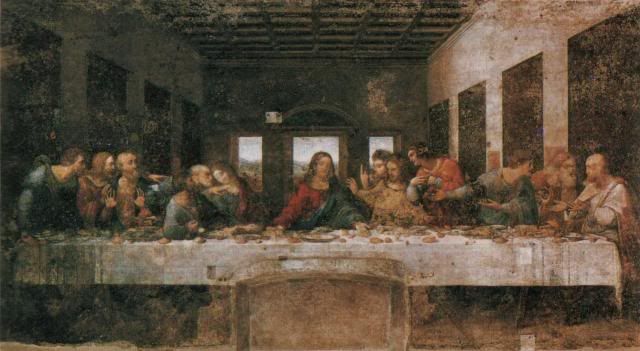
The Last Supper by Leonardo da Vinci was an experiment in oil based paint on a plaster wall primed with a lead based white paint. Most wall murals of the time were frescos where the artist painted a very small part of the wall with pigments on a wet plaster.
Leonardo was in a creative mood after he had to give up his huge bronze horse cast statute and his flying machine design. He decided to do his art commission for a monastery wall in oil paints because no one else had ever done it that way. If you look at photos of The Last Supper as it is today, you see why no one had. The present mural is stripped paint and faint colors and indistinguishable characteristics of the figures and the food at the last supper.
Da Vinci also chose the wrong wall to paint. It was the north wall and prone to dampness even in good weather. The Last Supper was a mural artwork experiment gone very wrong.
But on the positive side, Leonardo did finish the mural. And Leonardo was well known by all art patrons in Milan as an artist who did not start or finish his commissions unless they were small paintings of individuals.
Leonardo was a thinker of great ideas. His art was just a hobby or a palate cleanser while he tasted another idea with dreams of architectural or engineering glory.
This was a new one for me---an artist who really wanted to be an engineer.
Friday, May 3, 2013
A Clash of Cultures
A History of Future Cities by Daniel Brook
This book is a history of four cities: St. Petersburg (also in its Leningrad incarnation), Shanghai, Dubai, and Mumbai (in its Bombay incarnation).
The two cities that I found to be the most interesting were St. Petersburg and Shanghai. Both cities were founded by the imposition of the Western Enlightenment and its subsequent desire for trade with other cultures, the curiosity with other cultures, and the exploitation of a native culture for its own betterment and the West's.
Peter the Great, the Russian Czar, thought that he could import the Western Enlightenment into Russia by laying the groundwork of St. Petersburg. The mix of Western Culture and Russian Culture, after he wrested the area from the Swedish crown, would lead to a High Russian Culture that would rival and overtake the Enlightenment of Western Europe. All the good would flow to Russia, because that is the way the autocrat, Peter, wanted it. But, oh the Other People and the Little People, they don't know that they must serve the Autocrat not themselves. They will go and order things the way that they want them to be, not the way that their Betters Know That They Should Be. This problem persists in the World today.
Shanghai was also founded by a Briton who wanted to trade with the Chinese Empire. Britain had manufactured goods that needed markets preferably in China. The Chinese Emperor gave the land for the barbarians to use as their trading city, but then the Emperor refused to trade because the Europeans had nothing that the Chinese wanted according to the Emperor. Except for Opium from the British Indian Empire, the Chinese were willing to take some of that good stuff. In order to obtain the silks and lacquers and porcelain and art of the Chinese, Europeans only had, by the decree of the Chinese Emperor, Opium to trade. Hence the Opium War, a shameful war by all accounts on all sides.
Whereas Peter the Great made a city for the expansion of Culture and Trade, the Chinese Emperor made Shanghai to contain and contract the meeting of Cultures. It didn't work out well for either man's goals.
No Easy Day: An Autobiography of a Navy Seal: The First Hand Account of the Mission That Killed Osama Bin Laden by Mark Owen
I saw Zero Dark Thirty and wondered about the accuracy of the last part of the movie, so I read this book. The movie and book pretty much follow each other in the raid.
The rest of the book is about how Mr. Owen became a Navy Seal and what his training consisted of. The rest of the movie is about the wanderings in the Torture Desert of Moral Ambiguity to find the Devil. Both parts of those stories depend upon what the reader or viewer is really interested in.
The Iron King by Maurice Druon
Philip IV the Fair was the King of France in the later part of the thirteenth century. He decided that being a Temporal King was no great challenge and he went after the Papacy too. He made up his own Pope and then went after the wealth of the Templar Knights who ran the Crusades and financed many shenanigans throughout Europe.
Philip broke the Templar Knights (they are the ones that The Maltese Falcon belonged to) but didn't get anymore satisfaction out of it than did the Fat Man and Sam Spade. The head of the Templar Knights cursed Philip the Fair and his progeny to the thirteenth generation as he burned at the stake. And it appeared that the Curse did some Good or Bad as it was intended.
Philip the Fair died soon afterwards and his children and their children fell on hard ruling times and the Hundred Years War. The French ruling family, the Capets, died out. The Valois branch took over. The British ruling family of the Plantagenets (who were connected to the French Capets through intermarriage) fell apart and began the Wars of the Roses which gave Shakespeare the basis for his History Plays.
The book has a couple of subplots about a scheming knight and an Italian Banking House that were interesting sporadically. I usually just skimmed those parts. The royals are the interesting stinkers in this book.
Dorothy Dunnett's The Lymond Chronicles is a better written set of books about the mid-sixteenth century that gives intimate details of the history and culture and customs of Europe. It helps to know French and Latin for her books, although one can get by just fine without them. Mr. Druon doesn't have the depth of research nor gives the historical details that Miss Dunnett does, but he is a quick read.
Friday, April 12, 2013
Some Odd People
The Guilty One by Lisa Ballantyne
This book is a murder mystery that goes to trial where the truth to be discovered about the trial and whether the accused child murderer did what he is accused of is discernible about half way through the book and the trial.
The real mystery is why the child's attorney, or solicitor (this is a British mystery), is estranged from his adoptive mother and biological mother.
This is good trash reading.
That Furious Lesbian: The Story of Mercedes de Acosta by Robert A. Shanke
Mercedes de Acosta knew every one who was Any One in the early twentieth century. She was a lesbian groupie who slept with all the great lesbians of that age, Greta Garbo, Marlene Dietrich, Eva le Gallienne, Laurette Taylor, Alice B. Toklas, etc.
Miss de Acosta also wrote plays for the theater of the time and screenplays for Hollywood movies.
This is a good biography. It moves fast and explains the period and its people well to anyone who has not read much about it.
And Cecil Beaton was the one who called her a furious lesbian. Really Mr. Beaton, you are one to talk.
Wednesday, February 13, 2013
Interviews With Artists
Interviews in the Early Twentieth Century
When I saw Midnight in Paris, the lead character was dancing with one of the American Artists in Paris in the 1920s, and he was complaining about her insistence on leading. The Leading Lady was Djuna Barnes. I was doing some reading and research about that time and those artists and I had never heard of the Lady so I added her to the syllabus.
Interviews by Djuna Barnes was an good read not only for the American personalities of the 1910-1930s, but Miss Barnes was a breezy and inventive interviewer. She might put her subject in a one act play for the interview or she might take the interview and make the subject answer any of her questions with the platitudes and cliches and turns of phrase that the subject was known for. She could be as whimsical and as playful as Humpty Dumpty in Alice in Wonderland.
Now I know where the style and form of those short interviews at the beginning of The New Yorker's On The Town come from. Miss Barnes was doing it and doing it well before The New Yorker.
Performance Art in the Early Twenty First Century
I never thought that a novel about some Performance Artists would be very interesting to me. The main theme of a Performance Artist is Herself. And Most of them are just not as fascinating as they appear to be to themselves. A variety show or book about Performance Artists is much like Vaudeville. You have to sit through some boring and strange abusive acts to get to the headliner. And the headliner just might not be to your taste.
I Am Trying to Reach You by Barbara Browning is a novel about an academic who unartfully (have you ever read some of their papers on art and their "theories" of art? Nope, and there is a good reason for that. Most of them are incomprehensible even to other academics. Hmmm, there must be some Performance Art Academic Critics who can't even recognize their own Acts or Art to Criticize. But that way lies Madness and a Grant) criticizes Performance Artists and even some of his own Academic Scholars.
If this is getting too convoluted and circumlocutory like a Hexagon Mobius Strip for you, just ignore the previous paragraph because the narrator is likable and doesn't quite understand any of the Performance Artist's Performances himself. But like a Good Academic, he keeps up the effort to find some cosmic or even some neighborly meaning thereof.
While the Narrator muddles through his Art Theories, he does live life and that is where the crux of the novel lies. The Narrator attempts gallantry and just human concern for the Old Lady in a Walker who lives down his hallway. He deals with his lover who is a continent away and learning to live with and medicate a possibly fatal illness.
He follows a You Tube Video Dancer named falserebelmoth who makes dance videos that the Narrator is sure have some sub textual meaning to them. The video dances are just like life. They are there, and we are here and there, and meaning is stuck in the background or off to the side of the video, cut off by the video frame or in the shadows. If we could just see it or get it into focus. If we could just add some more pixels and make it sharper.
I actually went on You Tube to see if there were any videos by falserebelmoth and to see if I could see them through my own eyes and not the Narrator's eyes, but Miss Browning did not go that far.
She should have.
Sunday, February 10, 2013
History Lessons
The Noir Forties: The American People from Victory to Cold War by Richard Lingeman
This book is an informal history of the United States from 1940 to 1950. After discussing a section of history, the one on the economics of the period is truly boring and it shouldn't be because this is when a steel workers strike could stop the US economy cold, the author attempts to connect it to a movie of the time that echoes the concerns and fears of that history section. When was the last time that anyone has ever been frightened by a strike lately? How Labor has Fallen.
The movie that the author discusses along with the strikes of the period is The Long Night directed by Anatole Litvak that stars Henry Fonda as a World War II veteran with a bad case of PTSD who kills some guy and then barricades himself in his apartment and has flashbacks all movie long. I haven't seen the movie yet so I don't know just how that relates to Strikes other than barricading oneself in one's room is sort of like walking a picket line in a strike. You can only hope someone is paying attention and if you kill someone, you do draw some notice from authorities and the media.
The history, other than the economic side, is mostly interesting and well presented by the author. The connection with some of the movies (the ones that I have seen) is slight to incidental. The author is really not all that interested in the movie correlation side of the book. I assume that his agent or publisher made him include the movies in the book to make it easier to sell. The author's own experiences in the time period, he was a drafted soldier in Army Intelligence in Japan, were much more interesting and well presented. I assume that correlating his own experiences with the history period was what he really wanted to do and probably was what he originally did in the book before he had to tart it up with Hollywood blondes.
What I took away from this book was that America was having a moment of Mass Fear and Hysteria and Paranoia in the later part of the forties. The loss of FDR must have been truly frightening despite the winning of the war. The similarities with present day America are also disconcerting. Once again we have elected officials like Senator McCarthy, only today we have many of them not just one, who manufacture Fear crises like the National Debt and Bengazhi!!! and the Second Amendment to advance their careers over the Real Life and the Truth and The Way that It Really Is.
Hmmmm, perhaps this is why Fantasy and Science Fiction and Magic movies are so popular these days. The crazies want us all to share their delusions.
The Entertainer: Movies Magic and My Father's Twentieth Century by Margaret Talbot
This is another history book about the times and the movies of those times. It is also a memoir of Lyle Talbot, an actor who began as a Magician's Assistant at the beginning of the 20th Century, starred in Roaming Theatrical companies and their plays, and then went to Hollywood at the beginning of the Talkies Movies and made his career as a B-movie lead and later as the best friend of Ozzie Nelson in TV.
The book is written by one of his daughters, Margaret, and she includes family history and reminisces to give an even more intimate picture of her father and his career and his family. Miss Talbot does a good job with remembering her father's and her past. Like Mr. Proust, it is the little things that she remembers that become the crux of the interpretation of her and her father's life. She also writes well.
As for Mr. Talbot, I have seen one of his Pre-Code movies, Three on a Match, (Bette Davis is in this one, but this is before Warner Brothers figured out just how interesting an actress that she was and was still making her play unremarkable Good Girls. When you think about it, it is amusing, Miss Davis found her Bad Girl after the Era of Bad Girls in the Pre-Code movies. It is also a tribute to Miss Davis' ability to handle subtlety and subtext in her acting and that is amusing because I don't often think of subtlety when I think of Miss Davis' acting.).
Any way, I liked Mr. Talbot and his character in the movie that I was watching mainly for Ann Dvorak, a Pre-Code Female Star. Mr. Talbot played a stinker with some moral scruples, you felt sorry for the poor sod. I have seen some episodes of The Adventures of Ozzie and Harriet which was The Cosby Show of the fifties and sixties. I hated his character on that one. Mr. Talbot played the obnoxious neighbor and best friend of Ozzie. His character was one of those "Hail Fellow and Well-Met" men with idiotic jokes and Loud Camaraderie, and that shows just how undervalued his acting skills were when you compare the two characters.
Mr. Talbot was also in some of Ed Wood's cult classic Bad Films.
Monday, December 24, 2012
Escape From Affluence and Poverty and Sentiment
Escape From Camp 14 by Blaine Harden is the story of Shin Dong-hyuk who was born and reared in a North Korean Internment Camp. His father and mother were inmates who were favored by the guards and allowed to breed. They produced two sons, Shin and an older brother, in their long and dreary and cruel incarceration. Both sons managed to escape the camp, but in completely different ways.
Shin long blamed his mother and father for making him to be born and live in such hellish conditions. Shin ratted out his mother and older brother to the authorities on their escape plans for extra food and served six months in dark cell isolation and being tortured before being brought out to the daylight to watch the camp authorities hang his mother and shoot his brother before his eyes. Shin and his father got front row seats for that piece of Camp Theater.
After the execution of his mother and brother, Shin was placed in a cell with an older man who told him wondrous stories of the Food outside of the camp. Shin, who was overworked, undereducated, malnourished, and fresh from six months of torture which included beatings and being hung to roast over a fire, and the deaths of this mother and brother which were caused by Shin's informing on them, conceived of escaping from the camp to get him some of that food.
Forget Freedom, Shin just wanted to be able to eat to satiation. By the way, the torture was about the same as living in the camp, beatings and overwork and isolation from the children around him and little or no food.
Later Shin left his cell with his Gourmand Inmate and made the acquaintance of a newly arrived North Korean who made the mistake of going back to North Korea after a few years in the relative benign freedom of China. Shin and the new inmate conceived a plan to escape the camp while cutting wood near the camp's electrical fences. They carried out the plan, but only Shin made it out. He used the body of his escape buddy to neutralize the Electrical Fence and crawled over his dead companion to Food.
Although with his education (they only taught rudimentary reading and writing skills to the children in-between work details and beatings), Shin had no idea where China was or what it was, Shin made it to China and spent three years in the country learning a few things about the world and eating Food. Later South Korea paid him to come to their country and after a de-briefing (tattling is one way to make it in the World), South Korea paid to maintain him there.
But the years of deprivation in Mind and Body, left Shin with long term Mental Illness Issues. He has never really adjusted to life outside the camp. Shin now lives most of the time in California where he lectures on his experiences and life in the North Korean Camp. He travels frequently to South Korea for visits.
During his torture session after ratting out his mother and brother, Shin was shown some papers that he was able to read. He found out that his father was in the camp because two of his brothers escaped to South Korea during the Korean War. The remaining family was sent to North Korean Camps because they were considered contaminated by the two brothers' escape. Somebody has to feed and work for the rest of North Korea and the Kim Jongs.
By the way, Shin didn't even know who the Kim Jongs were until he escaped. Education was very shallow even with propaganda for the Camp Kids.
Shin is one of three people who escaped from North Korean Camps. The interns of the Camps are so cowed and overworked and starved that most of them don't even attempt to run. And most who make the attempt end up like Shin's mother and brother.
Remember, it ain't Freedom that motivates. It is FOOD.
Seating Arrangements by Maggie Shipstead
This book was recommended by Salon.
I got about halfway through it, but I didn't find any of the characters interesting. They were all annoying in their privilege. And there was this Middle Aged Man who was hitting on one of his daughter's Bridesmaids. The Bridesmaid wanted it too. But I didn't want to read about it.
I see the recommendation was by a middle aged man. Well, that explains a lot.
Cascade by Maryanne O'Hara
This book was another recommendation.
It's about a woman artist of the thirties who makes all the wrong decisions (love and art) but comes out right in the end. Her father makes what appear to be the right decisions, but they go haywire.
The best woman artist of the thirties character was in The Big Clock, a classic noir book and film.
I guess that I am just not that sentimental.
Subscribe to:
Posts (Atom)